
Author: Rehaula

  • The Four Brand Quadrants®: Where Does Your Business Sit? 

    The Four Brand Quadrants®: Where Does Your Business Sit? 

    Not every business is trying to solve the same problem. 

    Some businesses have built outstanding reputations through years of hard work but struggle to gain the recognition they deserve. Others seem to dominate attention and conversation despite delivering very little of substance. Some are entering the market for the first time and searching for traction, while others have earned a position of influence and are now focused on protecting it. 

    One of the biggest misconceptions in business is the belief that every organisation should be following the same marketing playbook. In reality, the right strategy depends entirely on where your business sits today. 

    Over the years, we’ve found that most businesses can be grouped into one of four distinct categories: the Quiet Achiever, the Industry Leader, the Newcomer and the Loud Mouth. 

    Importantly, this quadrant helps explain why some businesses continue to grow while others remain stuck, regardless of how much effort they put into sales, marketing or business development. 

    The Quiet Achiever 

    The Quiet Achiever is often the business that surprises you most. 

    It’s the company with a loyal client base, a strong reputation and years of proven experience. Their work is exceptional. Their customers trust them. Their team knows what they’re doing. Yet when you look at their brand, website or market presence, none of that strength is obvious. 

    The reality is that many of Australia’s best businesses spend decades focused on operational excellence while paying very little attention to how they present themselves to the market. They invest in people, equipment, systems and service delivery. However, marketing becomes an afterthought and this comes at an opportunity cost. 

    As a result, their competitors often appear larger, more capable or more established despite having less experience, fewer runs on the board and weaker customer outcomes. 

    The problem isn’t the business itself. The problem is the gap between what the business is and how the market perceives it – this is where brand comes in. 

    This is particularly common across agriculture, manufacturing, engineering, trade services and professional services, where reputation has traditionally been built through relationships and referrals. While referrals remain important, modern buyers are increasingly validating those referrals online before making contact. When your digital presence doesn’t reflect the quality of your business, opportunities are lost before the conversation even begins. 

    Many Quiet Achievers don’t need reinvention. They need alignment. They need their brand, website and marketing to finally communicate the level of expertise they’ve already spent years developing. 

    The Industry Leader 

    Industry Leaders are businesses that have successfully closed the gap between reality and perception. 

    Their capability is strong, but so is their ability to communicate it. Their market understands who they are, what they stand for and why they matter. 

    What makes Industry Leaders interesting is that they are not always the biggest businesses in their category. In many cases, they’re simply the businesses that own a clear position and consistently reinforce it. 

    They’re visible without being loud. They’re recognised without constantly demanding attention. Their customers, suppliers, staff and industry peers all tell a similar story about who they are and what they do. 

    This level of alignment rarely happens by accident. 

    It is usually the result of deliberate investment in strategy, brand, communications and customer experience over an extended period of time. Every touchpoint, from the website and social media presence through to proposal documents, media coverage and sales conversations, contributes to a consistent market perception. 

    Becoming an Industry Leader doesn’t mean you’ve reached the finish line either. Leadership is rented, not owned – why? Because markets evolve and so do competitors. It is dangerous to rest in your laurels whilst customer expectations shift. The businesses that maintain their leadership position are those willing to continue investing in visibility, innovation and relevance long after they have established themselves. 

    The Newcomer 

    Every successful business was once a Newcomer. 

    Whether it’s a start-up, a new division or an established company entering a fresh market, Newcomers face a challenge that no amount of experience can immediately overcome: nobody knows who they are. 

    At this stage, visibility and credibility matter more than scale. 

    Many Newcomers assume success comes from doing more marketing. In reality, their greatest challenge is often creating enough clarity to give that marketing a chance of succeeding. 

    People need to understand what the business does. They need to understand how it’s different. They need to understand why it’s worth considering over businesses that already have established reputations. 

    The temptation is to try to look like an Industry Leader from day one. The smarter approach is to focus on building strong foundations that support long-term growth. 

    A clear market position, a professional identity, a compelling website and a consistent message will always outperform a rush to be everywhere at once. Businesses that establish these fundamentals early create momentum that compounds over time. 

    The Loud Mouth 

    The Loud Mouth is often the easiest business to spot. 

    They’re highly visible, constantly promoting themselves and rarely short on bold claims. Their marketing appears everywhere, their messaging is confident and their social media is active. From the outside looking in, they can appear to be the dominant force in the market. 

    The challenge, however, is that visibility and credibility are not the same thing. 

    When the customer experience fails to support the promises being made, the inconsistency becomes difficult to hide. Enquiries don’t convert, customers don’t return and referrals don’t follow. The attention generated by marketing begins to expose weaknesses rather than strengths. 

    The Loud Mouth is a reminder that great marketing cannot permanently compensate for a weak foundation. The strongest brands are built from the inside out. Marketing should amplify genuine capability, not attempt to cover a weakness within it. 

    While Loud Mouths can often dominate conversations for a period of time, Industry Leaders earn something far more valuable: trust. 

    So, Where Do You Sit? 

    Most businesses don’t see themselves clearly. 

    The Quiet Achiever often assumes everyone already knows how good they are. The Newcomer overestimates how much market awareness they’ve built. The Loud Mouth mistakes attention for authority. Even Industry Leaders can underestimate the work required to maintain their position. 

    Understanding where your business sits is the first step towards understanding what it needs next. 

    That’s why we’ve developed the Rehaula Brand Assessment Quiz. 

    In just a few minutes, you’ll discover which quadrant best reflects your current position and receive practical recommendations tailored to your business. Whether you need to strengthen your foundations, improve visibility, sharpen your position or build the systems required to become an industry-leading brand, the assessment will point you in the right direction. 

    Take the quiz to discover where your business sits and get tailored advice on what you should do next.

  • The secret sauce to scaling your socials.

    The secret sauce to scaling your socials.

    If you’re treating social media like a digital billboard, you’re already behind. The businesses winning attention today aren’t posting more advertisements, service announcements or promotional graphics. They’re telling better stories. 

    At Rehaula, we have a simple belief: If it looks like marketing, it’s not doing its job. 

    The content generating the most reach, engagement and enquiries rarely feels like a sales pitch. Instead, it feels like a behind-the-scenes moment, a project update, an industry insight, or a story people genuinely want to watch. 

    That’s why we’ve seen a major shift towards low-fi and mid-fi video. 

    Why Video Is Winning 

    People connect with people. When people connect, they talk. That’s why video is so powerful. 

    A polished brand graphic might explain what your business does, but a quick video from a project site, workshop, office or client location shows people who you are, how you work and why they should trust you. 

    The most effective content doesn’t need a film crew, studio or six-week production schedule. It simply needs to be authentic, valuable and consistent. 

    Think project walkthroughs, team insights, client success stories, behind-the-scenes footage, event highlights, day-in-the-life content and quick educational videos. 

    That’s the content audiences stop scrolling for. 

    Your Team Should Be Involved 

    One of the biggest mistakes businesses make is expecting their marketing manager to create all the content. 

    The best content already exists inside your business. 

    It’s your project manager explaining a challenge. Your technician solving a problem. Your founder sharing a lesson. Your team celebrating a milestone. Your site supervisor showing progress on a project. 

    Every person in the business has stories, expertise and experiences worth sharing. 

    The more your team contributes, the more authentic your content becomes. 

    Scaling Through Storytelling 

    The brands growing fastest on social media aren’t creating content just about themselves. They’re documenting what they’re already doing. 

    Moments of what we call magic. Something unexpected. Something remarkable. Something interesting enough to make people stop scrolling and start sharing. 

    Take Dot the Bird, for example. What started as a simple social media post turned into a national news story. Nobody set out to create a viral marketing campaign. There was no elaborate content strategy behind it. It was simply a story that captured people’s attention and spread because people wanted to talk about it. 

    That’s the lesson. 

    The content that performs best is rarely the content trying hardest to sell something. It’s the content that sparks curiosity, conversation and connection. 

    Every business has moments like this happening every day. A challenge solved on-site. A project milestone reached. A customer success story. A team member doing something extraordinary. Most businesses simply aren’t capturing them. 

    When you consistently capture stories, turn them into low-fi or mid-fi video, and encourage your team to share their day with you, social media stops feeling like marketing and starts becoming a genuine business development tool. 

    The Secret Sauce Is Simple 

    Encourage your team to share content. Get mid-fi produced with Rehaula. And focus on telling better stories, rather than selling. 

    Because if it looks like marketing, it’s probably not doing its job. 

    So next time you’re looking for content ideas, don’t start by asking what you should post. Start by asking, what’s something interesting that you should you capture and share. 

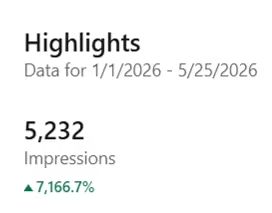
    Want your results to look like this?

    Need help with producing engaging content? 

    Speak to Rehaula

  • The rebrand that made front page news.

    The rebrand that made front page news.

    Most businesses announce a rebrand with a social post and move on. The thinking is often simple: launch the new logo, update the website, change the signage and let the market figure it out. 

    The problem is that brand recognition isn’t built overnight, especially when you’re changing the name of a business that’s spent decades building its reputation. Brand should always be amplified by Public Relations. 

    For Territory Water Solutions, a business with more than 30 years of history and recognition in the Northern Territory, the challenge wasn’t just rolling out a brand that covers 1million square kilometres of the NT, it was making sure that the NT new about it. 

    A Rebrand Means Nothing If Nobody Knows About It 

    One of the most common mistakes businesses make during a rebrand is assuming the market is paying as much attention to their business as they are. 

    The reality is most customers, suppliers and stakeholders are busy running their own businesses. They’re not watching your website waiting for a logo change. 

    When an established business changes its name or identity, communication becomes just as important as the rebrand itself. 

    Without a rollout strategy, businesses risk creating confusion rather than clarity. Existing customers may not immediately recognise the change. And when a name change is involved, you need to garner as much awareness as possible, to ensure awareness so that customers are managed, and importantly that equity is preserved and transferred. Prospective customers may not realise the new brand has decades of experience behind it, and all the same, the existing brand with decades of experience needs to transfer over its value. Valuable brand equity can be lost during the transition if not amplified well. 

    For a business with Territory Water Solutions’ history, we knew the market needed to know about the change. 

    The Importance of a Strategic Rollout 

    While much of the attention in a rebrand focuses on the visual identity, the rollout is often what determines whether the project succeeds commercially.  

    A strong rollout creates momentum. It gives customers confidence. It reassures stakeholders. It creates conversation. Most importantly, it helps transfer trust from the old brand to the new one. 

    For Territory Water Solutions, this was particularly important. We weren’t introducing a new business to the market. We were helping a well-established business bring the market with it as it evolved. After more than 30 years of building recognition, the last thing you want is customers, suppliers and stakeholders wondering whether they’re dealing with the same trusted business they’ve always known. 

    And don’t underestimate the challenge of a rollout of this size. 

    Before Rehaula was engaged, two separate agencies had attempted to manage the transition. Neither succeeded in generating the awareness and momentum the business needed – which is why they engaged us. That’s because a successful rebrand isn’t just about changing assets. It’s about developing strong assets that have the power to not only capture the market, but ensure that it understands the story behind the change and what the new brand represents. 

    That’s where strategic communications become critical. 

    Rather than quietly updating the brand and hoping people noticed, we proactively built awareness through media engagement, communications and a coordinated rollout strategy designed to put the new brand in front of the right audience. 

    Because when you’ve spent decades building trust, you can’t afford to leave brand awareness to chance. The market needs to know who you are, why the change happened and why they should continue backing the business they’ve always trusted. 

    And when that rollout is done properly, a rebrand becomes more than an internal milestone. It becomes a market event. 

    Turning a Business Update Into a News Story 

    Rather than waiting and hoping people would notice the change, we proactively engaged with media outlets and industry channels to ensure the story was being seen. 

    The result was media coverage that helped introduce the new brand to a broader audience and reinforced the message that while the name may have evolved, the capability, experience and reputation behind the business remained as strong as ever. 
     
    From radio, to front page news. We achieved what we set out to. Coverage that let the NT know just who Territory Water Solutions is, and where it has come from. 

    The Result 

    The outcome extended far beyond a single article. The rollout created awareness, generated conversation and gave the new brand a platform to enter the market with momentum. 

    Engagement across communication channels increased significantly compared to what the business had historically experienced under the previous brand. More people were seeing the content. More people were interacting with the business. More people understood the story behind the transition. 

    The Lesson for Businesses Considering a Rebrand 

    If there’s one lesson to take from the Territory Water Solutions story, it’s this: 

    Ensure your rollout strategy is as strong as your brand strategy. Launching a new brand without a communications plan is like building a new website and never telling anyone it exists. 

    The visual identity is only one part of the equation. The real opportunity comes from the story you tell around the change and the effort you put into ensuring the right people hear it. 

    Because the most successful rebrands don’t just change how a business looks. They change what people know about it. And sometimes, when the rollout is done properly, they even make the front page. 
     
    Well done Territory Water Solutions.